Capacity Building Series: Relationship Building with Funders (Part I)

Why do relationships with funders matter? Consider these facts:

  • Charitable giving reached a record high in 2020 with $471 billion donated to nonprofits. Foundations contributed $88.5 billion (Giving USA).
  • More than 1.6 million nonprofits are registered in U.S. (Urban Institute, National Center for Charitable Statistics 2000).
  • There are an estimated 115,000 foundations in the U.S. (Candid 2018).

So, what can a nonprofit do to stand out while also getting to know funders? In short, having a genuine connection with a funder can break through the competition. The goal is to build authentic relationships. At Methodist Healthcare Ministries, we know through experience that relationships built on false narratives, or projections of how you want others to perceive you instead of who you really are, won’t last. However, making connections by focusing on and prioritizing relationships and trust can help a funder get to know you. Remember, growing relationships is like any other organic process—they need tending on a regular basis.

Creating a Return on Relationship: Importance and Benefits of Relationship Building with Funders

You’re probably familiar with the term “Return on Investment” or ROI. What about ROR (Return on Relationship)? Ted Rubin, a social marketing strategist, trademarked the concept of Return on Relationship. Think about relationship building in terms of a Return on Relationship—there is value accrued due to nurturing a relationship. Relationships inherently are not financial assets; relationships are priceless.

Here are some ideas for increasing your Return on Relationship with funders:

Move beyond only being in a transactional mode with funders. Transactional actions can include questions about grant applications, grant guidelines, grant reports, etc. Instead, think of funders as allies. Funders want their current and prospective partners to succeed. So, find funder allies and then listen carefully to their suggestions regarding your partnership to get the most out of the financial support provided and, perhaps, support beyond the check such as capacity building services. Funders often have expertise, insight, and social capital you can use to be more successful. Many nonprofits and grantees miss out on useful opportunities because they are solely focused on just getting the money versus building a relationship.

Be transformative. Strive to interact in a transformative mode with funders. Being transformative is dynamic. It’s your organization engaging outside of the grant cycle time period. It’s storytelling – your organization’s current events, future plans, and outcomes; sharing ideas or ways to be more strategic. It’s important to set realistic expectations of how much time funders can spend with a partner or prospective partner, so keep balance in mind.

Initiate engagement. Be proactive and seek out funders. This is especially important when it comes to rural grant seeking & philanthropic deserts; funders likely won’t find you. You have to find them!  Some resources to help with rural grantseeking:

Seek peer advice. Don’t forget your peer organizations in your relationship building strategy with funders. Search a foundation’s list of recent grant recipients. If a peer organization has recently received funding, reach out to ask how they established the connection. While grant seeking is competitive, your peer organizations will understand that foundations often have diverse funding interests and will trust you to build a relationship based on your organization’s unique programs and services. Incorporate the tips and feedback you receive from your peers into your cultivation strategy.

Understanding the “Foundation” of Foundations

Understanding Foundations

⇢ What is a community foundation?

⇢ What is a private foundation?

⇢ What is a corporate foundation?

Source: insidephilanthropy.com

Once you know the different types of foundations–Community,
Private, Operating, and Corporate–you can then research how foundations operate and discover their “why” and/or purpose. Knowing this information can help you vet foundations and grant opportunities more appropriately. In your vetting process, look for alignment with organization type, programs, and services that have been funded. Research the typical grant award; grant periods (one year or multi-year); criteria for funding; funding restrictions; timelines; grant guidelines and application process, etc.

A community foundation is a grantmaker that serves a specific community or region. Distinct from a private foundation, which is usually funded by a single individual, family or corporation, a community foundation is a public charity that is funded by many donors and governed by a board that reflects the community it serves. Examples: San Antonio Area Foundation, Coastal Bend Community Foundation, and Community Foundation of the Texas Hill Country.

A private foundation is a non-governmental agency who might be an individual or family that establishes a private foundation to give money (and sometimes other resources) to nonprofits engaged in charitable activities. Examples: Meadows Foundation, Nancy Smith Hurd Foundation, and Anderson Charitable Foundation.

A corporate foundation is a private foundation whose money is contributed by a for-profit business. Think Home Depot or State Farm.

An operating foundation is a private foundation that provides public programming and services and charitable funding. Examples: St. David’s Foundation and Episcopal Health Foundation.

Be curious – Funders who don’t accept unsolicited proposals? Consider and approach funders who don’t accept unsolicited applications if they are a good funding fit for your organization’s work and mission. Many of these foundations are willing to consider new applicants but are using other methods to learn about potential partners to limit the number of proposals they have to review. Your organization deserves to be considered. Don’t dismiss a prospect just because you have read that they do not accept unsolicited proposals, especially if it fits your organization’s work and mission. It doesn’t hurt to ask. Don’t tell yourself no by assuming they’ll tell you no. If it’s a no, then let them tell you no. 

Source: https://help.candid.org/s/article/applications-not-accepted

Look at the funder’s grant awards from the last several years to see its giving trends. The funder could be a good prospect if the funder awards grants to different organizations from year to year, has a similar funding priority to your organization’s mission, and makes grants in your geographic region. However, if a funder makes grants to the same organizations year after year, you might consider looking at other funders instead.

Source: https://help.candid.org/s/article/applications-not-accepted

*In Part 2 of this blog, we will focus on a multitude of ways your organization can approach funders, initiate engagement, and maintain relationships with funders.

MHM.org author pics

About the author: Chloé Laurence (she/her)

claurence@mhm.org

With a professional background working in education, mental health counseling spaces, and the nonprofit sector, Chloé serves her community through education, advocacy, and capacity building. She utilizes her love of learning and connecting with people in her work as a Capacity Building Specialist at Methodist Healthcare Ministries to support and empower our funded partners. Her mission is to strengthen our partners’ organizations so they can continue their incredible work building health equity and serving underserved individuals.

November 2023 Calendar of Events – WHWC

Methodist Healthcare Ministries’ Wesley Health & Wellness team offers a wide variety of programs and classes designed for every skill level! All classes are free and open to the public. Registration is required, call (210) 922-6922 to register.

Click here to download a copy of our Wesley Health & Wellness Center – Calendar of Events for November 2023.

English

2023 November Calendar_Page_1

Español

2023 November Calendar_Page_2

Early Voting Begins in Texas

Early voting in Texas begins today, October 23, for fourteen amendments to the Texas constitution. Each one is the result of legislation passed during the 88th Texas Legislature earlier this year.

Methodist Healthcare Ministries advocated for several of the propositions on the ballot. They positively impact nonmedical drivers of health, improving the health of Texans and the patients we serve.

Proposition 2 – Childcare facilities

This amendment allows cities and counties to provide a property tax exemption for childcare providers if a minimum of 20% of their students receive subsidized childcare services. The exemption must be at least 50% of the property’s appraised value and does not apply to school district taxes or home-based childcare providers who have already received a homestead exemption.

Proposition 4 – Property taxes / school funding

This amendment lowers school district property taxes. Specifically, the amendment:

  • Increases the amount of homestead exemptions from $40,000 to $100,000.
  • Releases an additional $7.1 billion appropriated to school districts during the 88thTexas Legislature to lower property tax rates.
  • Imposes a temporary 20% cap on increases in the taxable value of appraisals for commercial, mineral and residential properties that do not receive a homestead exemption and are worth less than $5 million. The cap expires in 2026.
  • Expands the pool of business that do not pay the state franchise tax.
  • Allows voters to elect three members to the local appraisal district board of directors. (The members are currently appointed).

Proposition 6 – Texas Water Fund

The 88th Texas Legislature created the Texas Water Development Board to oversee projects throughout the state recognizing clean water is essential for healthy communities. This amendment creates a fund within the state treasury, endowed with $1 billion to begin to address the state’s significant water issues.

  • A minimum of 25% of the fund is dedicated to the New Water Supply Fund for Texas, supporting projects to increase the state’s water supply from nontraditional sources such as saltwater desalination.
  • The remaining 75% is for the Texas Water Fund which aids in infrastructure repairs, obtaining new water sources, mitigating water loss at existing facilities and ensuring future water availability.

Proposition 8 – Broadband infrastructure fund

The Texas Broadband Development Office estimates 3 million Texas households do not have broadband internet connections and an additional 5 million households have unreliable connections. Most live in rural areas. The amendment provides $1.5 billion to develop and finance broadband, telecommunication and 911 services as well as provide matching funds for federal grants from the Broadband Equity, Access and Deployment Program.

Proposition 10 – Medical and biomedical products 

This amendment exempts biomedical equipment and inventory when calculating a facility’s appraised value for property tax purposes. All taxing entities are included (city, county, school districts and special taxing districts) in the exemption. The rationale for giving the exemption is more manufacturers will choose to locate their business in Texas with a more favorable tax situation.

For more information about any amendments on the ballot, including arguments for and against each amendment, visit the nonpartisan voter guides published by The Texas Tribune or the League of Women Voters.

Everyone is encouraged to exercise their right to vote. Early voting runs through Friday, November 3. Election Day is Tuesday, November 7. To find your polling location and hours, visit the Texas Secretary of State’s website.

Funded Partner Spotlight: Community Council of South-Central Texas, Inc.

Since 1995, Methodist Healthcare Ministries of South Texas, Inc. has provided over $1 billion to improve the well-being of the least served through its clinics, programs, and strategic partnerships. Methodist Healthcare Ministries is proud to partner with organizations that share similar missions and organizational objectives of increasing access to care for uninsured and economically disadvantaged individuals and families across South Texas.  

In the months following November 1963, just after President John F. Kennedy’s assassination, President Lyndon B. Johnson carried on Kennedy’s plans to alleviate the burdens of Americans living in poverty. Later the next year, Congress passed the Economic Opportunity Act, which established and funded Community Action Agencies and Programs. By 1968, there were over 1,600 agencies across America serving the country at a local level. 

One of these Community Action Agencies, the Community Council of Comal County was established in 1965. In 1981, the change in funding from the federal government to state Block Grant funding led the organization to be renamed the Community Council of South-Central Texas (CCSCT).  

Almost 60 years later, CCSCT has expanded to serve 31 counties across South, Central and West Texas with the objective of promoting and delivering much needed services to low-income families in their service area. Case by case, CCSCT uses their network of over 1,000 partner nonprofits and programming to help families on their journey to becoming fully self-sufficient.  

In 2023, Methodist Healthcare Ministries (MHM) provided $100,000 in grant funding to CCSCT to fund their housing support programs across their service area. The grant also supported the renovation of a new public outreach facility in Karnes County, where unhoused individuals can come for connections to resources, as well as use printing and computer services.  

“It (the grant funding) has been instrumental in providing assistance to low-income families when funding is low or when we are unable to serve that population,” Carol Delgado, program officer at CCSCT, commented. “MHM funding has allowed us to provide assistance that we normally wouldn’t be able to provide.”  

The grant provided by MHM will also, in part, go towards the building of a new outreach facility in Karnes County with the hopes of providing basic resources such as a computer lab, breaking down transportation barriers, as well as directing clients to much-needed programs offered by CCSCT.  

 “A homeless person or unhoused person is not going to be able to travel to our Seguin office or our Jourdanton office so they can go through the front door [at our Karnes office],” Kenneth Loy, Program Manager and Veteran’s Resource Coordinator, commented. “It allows people down there to have a local place to help address an unhoused issue.”  

One of the programs CCSCT provides is home and rental assistance in the form of the Tenant-Based Rental Assistance program (TBRA) which offers security and utility deposits as well as rental subsidies for up to 24 months while the household engages in a self-sufficiency program. Securing safe and secure shelter as well as food and water is key to facilitating access to healthcare and other needs for unhoused populations.  

 CCSCT also provides support for eligible former members of the military through their Veteran’s Financial Assistance program. The program is supported by a grant from the Texas Veteran’s Commission Fund for Veteran’s Assistance and provides short-term services such as one-time utility payments and one-time rent or mortgage payments.  

The ERA2 program is an initiative set forth by the U.S. Department of the Treasury to assist eligible families with financial assistance and housing stability. It’s through this program that CCSCT has been able to receive funding to help transition families and individuals out of homelessness and into permanent living spaces. CCSCT has seen a 40% success rate with transitioning eligible households from temporary and semi-permanent living areas and into permanent housing.  

“The two basic needs that people look for are food and shelter,” Loy said. “And so, when you address food and shelter, you allow a person the freedom to do other things like pursue healthcare.”   

If you or a loved one would like to contact the Community Council of South-Central Texas, visit their website and find a location near you to get in contact with a representative today.  

CCSCT Website: https://www.ccsct.org/  

CCSCT Logo

Celebrating our 2023 SA Worx Summer Interns

For some recent high school graduates, the summer before starting college is filled with days at the pool, spending time with friends, and maybe preparing for their first time living away from home. For Bobbie Campos, oral health intern, summer is an opportunity to learn, grow, and serve her community. Campos is currently completing her second internship with the oral health team at Methodist Healthcare Ministries’ Dixon Health & Wellness Center as part of the 2023 SA Worx program, where she and other interns are developing lifelong transferrable skills that they can take to any career.  

The SA Worx program connects students across San Antonio to internship opportunities with organizations working in their areas of interest. It is an industry-led program that provides educators with student resources to pass along while also creating a reliable source of strong talent across multiple industries here in San Antonio. 

MHM has participated in the SA Worx program for over 7 years and continues to be the program’s largest partner with over 28 interns housed in facilities across San Antonio for the 2023 program. Interns at MHM can select an area of interest such as oral health, behavioral health or recreation and work on-site with MHM team members serving our patients and clients.  

Interns are also encouraged to attend several workshops that further enhance their experience at MHM while providing professional development opportunities for the students. Workshops covered topics such as Gallup Strengths, where interns learn more about their strongest qualities and how to use them for professional growth.  

“It has made me look at my strengths in our strength finders’ workshop, we learn different strategies that help you realize everything that you want to be and everything you’re already good at,” Savanna Rodriguez said. “So that way, you can grow in that area.” 

Rodriguez is currently completing her second internship at MHM as a Behavioral Health Intern, an opportunity that has allowed her to grow personally and professionally over the years.  

“I have anxiety going in crowds and just sparking up a conversation. But here I’ve learned that you don’t have to be scared because everybody is very welcoming here specifically.” Rodriguez said. “But even if they’re not, I’ve learned that you can be that welcoming person and you can spark up the conversation when somebody else feels nervous.”  

MHM’s Talent Management team, consisting of Brittani Dmitriev and Diane Rodriguez, have facilitated the partnership with SA Worx and the internship program. Together, they manage the interns by department and facilitate learning opportunities throughout the duration of the program.  

“Seeing the interns that returned from last year to this year, you can definitely see the difference,” Dmitriev said. “They’re very confident in themselves and in the work that they’re doing. It’s giving them experience and it’s also helping them personally just grow, from teenager to young adult.”  

The interns are now completing their final week in the internship program as schools preparing to reopen for the upcoming school year. While most of the interns will be returning to complete high school, Bobbie Campos will be starting her first semester at Palo Alto College’s dental program.  

“It has inspired me to go into this occupation. I knew I wanted to be in the dental field, but I didn’t know which part.” Bobbie said. “So just getting the experience in the different areas made my mind so set on being a dental hygienist.”  

Are you or someone you know interested in the SA Worx program and interning at MHM? Visit the link below to learn more about the SA Worx program and how you can apply for the next cohort:  

https://greatersatx.com/sa-worx/programs/internships/ 


Men’s Health Awareness Month – One Patient’s Access to Care Journey

June is recognized as Men’s Health Month across the nation and it’s a time to encourage men everywhere to take a proactive approach to their health and wellbeing. With over 13.2% men over the age of 18 considered to be in poor health, according to the CDC, it’s important to create a space to share stories and resources that emphasize the holistic wellbeing of the men in the communities we serve.

At Methodist Healthcare Ministries, we have a variety of programs and resources to help men along their health journeys. One story from our Wesley Nurse program is a great example of how men can utilize these resources to get access to care for unique issues they face.

On Wednesday nights, Marlene Anders, our Wesley Nurse in Travis County goes to the Lakeway Food Bank where she works with community members to provide food for low-income individuals in her area. As the MHM Wesley Nurse in that area for over nine years, she’s built a network that provides help to each other when needed.

“It’s a system that I just find remarkable because I collaborate with them and sometimes people will come in and say that if you can help them with this, they’ll help you with that,” Marlene said. “It’s a very give and take relationship and it works very well.”

Although Lakeway City is a higher income area with an average household earning around $143,000 per year, according to the U.S. Census (2017-2021), there are still what Marlene calls “pockets of poverty” where people live without access to clean water, plumbing or even showers. These communities are around HWY 62 and Apache Shores where inhabitants are often unseen and sometimes unwanted.

Marlene met one of these community members through working with the Food Bank and happened into a conversation she was not expecting. The man had been a client of the food bank for several years, but she had not had the chance to meet with him yet.

“My badge said I was an RN so he started up this conversation and I could tell he was anxious. I could tell he was in some kind of pain and so he just kind of blurted out his problem,” Marlene said. “And it took me back a little bit because that’s one issue I haven’t come up against and it had me going through all of my knowledge from school.”

The patient noted a strange pain in his groin and trouble urinating which after diagnosing as a testicular hydrocele, Marlene recommended that the patient immediately go to an emergency room.

The patient, who did not have insurance, worked with Marlene to apply to the Travis County Medical Access Program or MAP. Through this process, Marlene also found out that the patient lived in a small lean-to shed in Apache Shores where he did not have access to toilet or shower facilities. The patient also had no access to transportation, making access to care much more difficult. After this process, she met with the patient at Seton Emergency Room after arranging transportation and prior paperwork.

“They ended up calling the security guard on him because they thought he was a homeless person,” Marlene explained. “This is what he’s up against.”

From there, Marlene worked with the patient to undergo an operation that would temporarily relieve the pain and other symptoms by negotiating with the clinic staff to bring down the out-of-pocket costs for the procedure to $84 which she paid using Wesley Nurse special funds. While the procedure was only temporary, she’s still working with the patient to acquire personal transportation and access to a more permanent solution to his health issue.

“It’s an ongoing process,” Marlene said. “Not anything that happens overnight, because they didn’t get into their situation overnight either.”

Marlene, who has been with MHM for over 26 years since she started in 1997, has worked with many patients who face extreme poverty and the biases that come with it. There are over 3.7 million people in Texas living at or below the poverty line and over 5 million individuals without health insurance according to data from Every Texan, formerly the Center of Public Policy Priorities.

“We’ve been talking a lot about health equity and the state where everybody can attain their full potential of health no matter what their circumstances.” Marlene said, reflecting on the experience with the patient. “But we’ve always been doing it. I think that what I do now is the same as what I did back in 1997.”

At MHM, we approach health from a holistic perspective that considers the entire wellbeing of our patients and communities. For more information on men’s health and resources to share, view the links below.

Additional Resources:

May 2023 Calendar of Events – WHWC

Methodist Healthcare Ministries’ Wesley Health & Wellness team offers a wide variety of programs and classes designed for every skill level! All classes are free and open to the public. Registration is required, call (210) 922-6922 to register.

Click here to download a copy of our Wesley Health & Wellness Center – Calendar of Events for May 2023.

English

2023 May Calendar-MHM_Page_1

Español

2023 May Calendar-MHM_Page_2

March 2023 Calendar of Events – WHWC

Methodist Healthcare Ministries’ Wesley Health & Wellness team offers a wide variety of programs and classes designed for every skill level! All classes are free and open to the public. Registration is required, call (210) 922-6922 to register.

Click here to download a copy of our Wesley Health & Wellness Center – Calendar of Events for March 2023.  

English

2023 March Calendar (Comm) (1)_Page_1


Español

2023 March Calendar (Comm) (1)_Page_2

February 2023 Calendar of Events – WHWC

Methodist Healthcare Ministries’ Wesley Health & Wellness team offers a wide variety of programs and classes designed for every skill level! All classes are free and open to the public. Registration is required, call (210) 922-6922 to register.

Click here to download a copy of our Wesley Health & Wellness Center – Calendar of Events for February 2023.

English

2023 Feb. Calendar 1 - Clean- Comms Updates_Page_1

Español

2023 Feb. Calendar 1 - Clean- Comms Updates_Page_2

December 2022 Calendar of Events – WHWC

Methodist Healthcare Ministries’ Wesley Health & Wellness team offers a wide variety of programs and classes designed for every skill level! All classes are free and open to the public. Registration is required, call (210) 922-6922 to register.

Click here to download a copy of our Wesley Health & Wellness Center – Calendar of Events for December 2022.

English

2022 Dec. Calendar_Page_1

Español

2022 Dec. Calendar_Page_2

A Closer Look at MHM’s Strategic Focus Areas

Advancing health equity is a long-term commitment that requires multiple approaches. To guide its strategic efforts for increased impact, Methodist Healthcare Ministries of South Texas, Inc. has defined three focus areas that will act as a roadmap for the next ten years of its work: Transform Internal Processes and Culture, Strengthen Communities, and Impact Systemic Changes.

Strategic Focus #1 – Transform Internal Processes and Culture

Methodist Healthcare Ministries will transform its culture, internal capacity, and processes to advance health equity.
This will include advancing a culture of equity, diversity and inclusion, increasing an understanding of and competency in applying an equity lens to our organizational work, policies, processes, and procedures; and fostering greater intentionality in our pursuit of broadening the definition of health care.

Some of our work in the area of internal transformation includes:

Methodist Healthcare Ministries became the first organization to attain a Level 1 – Trauma Informed Certification from the Ecumenical Center in August 2021.

– Becoming a Trauma Informed Care-certified organization in Summer 2021. Methodist Healthcare Ministries became the first organization to attain a Level 1 – Trauma Informed Certification from the Ecumenical Center, the certifying entity for the South Texas Trauma Informed Care Crisis Consortium. Trauma Informed Care practices can help improve client, patient, and employee relationships, and help organizations avoid re-traumatizing those who have experienced trauma in the past.
– Starting the journey of implementing intentional anchor strategies that leverage local community assets in our operations. We are increasing our focus on contracting and spending with Small, Women and Minority Owned Business Enterprises (SWMBE) and Veteran-Owned Businesses (VOB). Methodist Healthcare Ministries conducted an internal analysis of our spending with SWMBEs and VOBs; finding that 32% of our 2020 dollars spent were with SWMBEs and VOBs, and this increased to 46% of total spending in 2021. Organizational goals and practices have been set in place to continue identifying opportunities to increase spending with these vendors.
– Engaging in learning and dialogue to foster increased understanding of equity, diversity, and inclusion. Building upon this increased understanding to integrate practices and policies are key to transforming our internal culture.
– Adjusting our internal processes and culture, the organization recently increased the minimum starting wage to $15/hr to improve the overall standard of living for team members and their families. This is another example of Methodist Healthcare Ministries shifting its internal policies in pursuit of supporting health and well-being for all.
Strategic Focus #2 – Strengthen Communities
Methodist Healthcare Ministries’ will build upon the capacity of Resilient Families and Thriving Communities to reach their full potential for health and life. This focus area encompasses the majority of Methodist Healthcare Ministries’ work and a variety of ways in which the organization will be able to engage and support communities. This includes but is not limited to community investments, clinical care, regional health and wellness programs and services, and working alongside community members as we focus on place-based strategies.
As one example, in March of 2021, Methodist Healthcare Ministries launched the first Prosperemos Juntos | Thriving Together Learning Collaborative, which is the initial means by which it will support the development and growth of communities of solutions throughout south and central Texas. Nonprofits, faith communities, schools, and other groups in Bexar County and South Texas who are part of the learning collaborative identify a vital community condition with community residents most affected by poverty, racism, and other inequities and develop strategies to address root causes.  Each annual learning collaborative is a capacity-building opportunity for communities in south and central Texas to substantially accelerate their health equity journey.  Methodist Healthcare Ministries believes communities have the solutions to improve their health and well-being. Each learning collaborative equips community-driven coalitions with skills and resources to strategically advance health equity, using the Institute for Healthcare Improvement’s Pathways to Population Health framework[TV1]  as a guide.

Methodist Healthcare Ministries opened the new Dixon Health & Wellness Center on San Antonio's East Side in 2019.
Methodist Healthcare Ministries opened the new Dixon Health & Wellness Center on San Antonio’s East Side in 2019.

Methodist Healthcare Ministries also has a long history of other areas of work in Strengthening Communities. As an example, in San Antonio, the Wesley Health & Wellness Center and Dixon Health & Wellness Center offer affordable medical, dental, and behavioral health services to individuals who are uninsured, as well as a full range of other services dedicated to treating the mind, body, and spirit.
In addition, the organization operates two George Ricks School Based Health Centers to provide comprehensive, primary health care, behavioral health, and dental services to children and their siblings enrolled in the Marion and Schertz-Cibolo-Universal City Independent School Districts in Guadalupe County.
Wesley Nurses, who are mostly located within churches across Methodist Healthcare Ministries’ service area, and part of Methodist Healthcare Ministries’ ecumenical outreach, provide holistic services, including health education, health promotion, and access to resources. They are uniquely embedded within the 74-county service area. Community Health Workers/Promotoras are also uniquely embedded and often come from the communities in which they serve. They reach out to, connect with, and engage individuals and families to help improve health outcomes for the clients they serve.
Through Patient Centered Medical Home (PCMH), Methodist Healthcare Ministries is committed to providing high quality, affordable care that is centered around each patient. Using evidence-based practices, providers listen carefully to each patient and offer integrated medical, behavioral, and oral health care that is coordinated alongside parenting and wellness classes so that each patient has the opportunity to thrive.
Methodist Healthcare Ministries is on a journey of developing trust-based philanthropic approaches to grantmaking. This encourages funded partners to be creative in developing projects, programs, and services that support resilient families and thriving communities within the service area.
Strategic Focus #3 – Impact Systemic Change
Methodist Healthcare Ministries plans to invest in efforts to address systemic and root causes of health inequity to disrupt the cycle of intergenerational poverty.  We are committed to digital inclusion, economic mobility, food security, and access to care.
The organization is investing resources into a variety of efforts to impact systemic change. As one example, last year the organization supported state legislation for the investment in Texas broadband infrastructure to address the nearly one million Texans living without access to broadband at home. HB 5 created a State Broadband Development Office to research the expansion, adoption, and affordability of deploying broadband services and programs to underserved areas of the state.

Methodist Healthcare Ministries announced the launch of a two-year economic mobility study in San Antonio in July 2022.

The organization is also commissioning a two-year economic mobility research study (randomized control trial) to examine the effectiveness of well-known interventions working together and separately for individuals in priority zip codes across San Antonio. We hope to apply what we learn to future investments of resources in support of economic upward mobility for individuals and families across South Texas. Read more about the study here.
To increase access to care, some of Methodist Healthcare Ministries legislative advocacy work is focused on Medicaid Expansion. We are working on expanding Medicaid for more Texans and connecting residents in San Antonio and the Rio Grande Valley with mental health services.
Methodist Healthcare Ministries’ other work builds upon the organization’s access to care work and goes beyond by addressing social needs. Methodist Healthcare Ministries has partnered with a local federally qualified health center (FQHC) and a faith-based organization to address social needs and provide services to underserved, low-income populations. Methodist Healthcare Ministries is working with organizations in northeast San Antonio to create a hub of resources for community members that will include access to a clinic providing medical, dental, and behavioral health services, as well as a food pantry, educational opportunities, a nearby transportation center, a place of worship and more. The hub will also house one of our Wesley Nurses, who specialize in the facilitation of resources and faith-based community nursing. All of these resources, centrally located, will help increase opportunities to engage the community and improve health equity within this area. Initial operation of this Hub Concept is expected to begin in the first quarter 2023.
All these efforts are aimed to help improve health equity in the communities we serve and translate strategy into improved community conditions and better quality of life.
***
Learn more about what Methodist Healthcare Ministries of South Texas, Inc. is doing on its transformative journey through the Advancing Health Equity blog series on mhm.org. If you have any questions, please email us at healthequity@mhm.org.
To read previous entries in the health equity blog series, see below:
Advancing Health Equity: Changing Health Outcomes

An Economic Mobility Study Building Upon the Strengths of San Antonio

On August 31, Methodist Healthcare Ministries, along with key partners and members of the community gathered at The Neighborhood Place in the Westside of San Antonio to learn more about how economic mobility approaches and interventions can positively impact the city of San Antonio and other communities.

The more than 100 attendees at the event listened to a keynote presentation by Charles J. Homer, M.D., M.P.H who has served as a clinician and researcher on national healthcare, education, and economic mobility focused initiatives. His presentation gave an in-depth look into why it is important to address inter-generational poverty in our communities and strategies that promote economic mobility.  He also discussed how different interventions, such as cash assistance, and science-based coaching and recognition, can work together to  positively impact individual and community-wide health and life outcomes.  Click here to view his remarks.

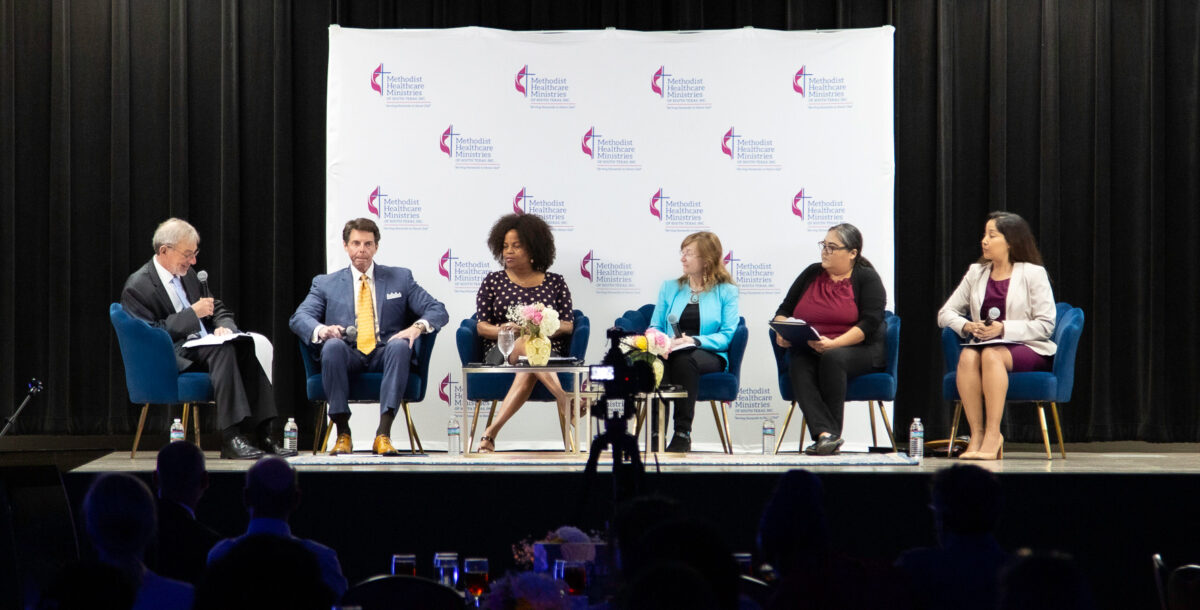
After lunch, a panel discussion focused on how one local intervention—the San Antonio G.O.A.L.S.  Initiative—has the potential to transform and strengthen the financial independence and well-being of resilient individuals and families.  Click here to read more about the San Antonio G.O.A.L.S. Initiative.  The panel, moderated by Dr. Homer, included representatives from our key community partners on the G.O.A.L.S. Initiative, alongside our President & CEO, Jaime Wesolowski.

Community Conversation Panelists

  • Charles J. Homer, M.D., M.P.H (moderator)
  • Jaime Wesolowski, President & CEO, Methodist Healthcare Ministries
  • Kim Janey, President and CEO, EMPath 
  • Mary Garr, President and CEO, Family Service  
  • Andrea Figueroa, Executive Director, Empower House 
  • Erica Sosa, Ph.D., Associate Dean for Research and Associate Professor, Public Health, UTSA HCAP

The San Antonio G.O.A.L.S. Initiative

Methodist Healthcare Ministries commissioned The University of Texas at San Antonio College of Health Community and Policy (HCAP) to serve as third-party evaluators of the economic mobility research study, looking at two different interventions: cash assistance and economic coaching, specifically EMPath’s Mobility Mentoring®.

The research focuses on understanding how Cash Assistance and a type of partnership called Mobility Mentoring® contribute to financial stability and economic mobility in Bexar County.  We want to understand the combined impact of these interventions on financial self-sufficiency, while learning about the factors or participant characteristics that affect the impacts of the interventions.  We want to learn about what works best for different people in Bexar County. Recruitment is currently underway . The application is open to individuals ages 18-60 who live in one of 13 priority zip codes with an income that is less than 150% of the federal poverty line. Families living in these zip codes have some of the highest levels of poverty in Bexar County. One person per household may apply, and 575 people will be selected to participate.

After two years, we hope that the findings we learn can help inform our future strategies and investments around economic mobility, as well as serve as a model for other communities and organizations to follow. Ultimately, we want to see what impact these interventions can have on health and well-being of these community members and imagine what this could mean for all of South Texas.  

During the Q&A portion of our community conversation, several attendees asked how the G.O.A.L.S. Initiative would take into consideration the difficulty our communities experience with participation in research. Attendees shared that fear of discrimination, language difficulties and lack of access to healthcare were some of the reasons community members do not participate in research studies.  The G.O.A.L.S. Initiative is internally guided  by Dr. Inez Cruz, who leads Methodist Healthcare Ministries’ research efforts. Dr. Cruz acknowledged that “historically a tension exists between diverse communities, especially  communities of color, and research recruitment.”   She noted that two prominent deterrents to participation in research studies are lack of trust and appropriate incentives.  However, over the years Latino researchers, and researchers in general, have striven to address these concerns.

Dr. Cruz added, “As a researcher, I need diverse communities, to participate in research if we want our findings to be reflective of the community we serve.”  For San Antonio, this means not only Latino/a/x, immigrant, and Black community members but also other individuals and communities historically underrepresented in research, including indigenous communities and people with disabilities. The G.O.A.L.S. Initiative began with community surveys and focus groups to ensure that our research directly incorporated community feedback.  Methodist Healthcare Ministries has partnered with trusted community-based nonprofits (Family Service and Empower House).  The study will be accessible to participants in English and Spanish and we will also work to accommodate other languages and individuals with disabilities in an effort to reduce barriers to participate.  And finally, the G.O.A.L.S.  Initiative  recognizes the value of our community’s time and expertise.  At a minimum each participant can receive $250 in gift cards over the two years for completing surveys with the potential for either economic coaching, cash assistance or a combination of both.

Why is Methodist Healthcare Ministries supporting this effort?

Two years ago, Methodist Healthcare Ministries commemorated 25 years of service to communities across South Texas.  As we crossed the quarter-century mark, we asked ourselves: “Were the health and well-being of communities across South Texas improving?”

The answer for many of our patients and clients was—yes! However, when we looked at overall population health metrics across communities in our service area, we saw that many community-wide metrics were not improving.  We knew we had to set a course for the next 25 years to make broader, community-wide impact. So, we committed ourselves to a new strategic vision and plan rooted in health equity.

Methodist Healthcare Ministries’ Commitment to Health Equity:
Methodist Healthcare Ministries of South Texas, Inc. believes that to improve the wellness of the least served and fully live out its mission of “Serving Humanity to Honor God,” it must recognize the inequities inherent in its communities that contribute to poor health outcomes. Health Equity is both the process and goal by which Methodist Healthcare Ministries seeks to carry out that purpose. Health Equity is a framework of thought and action that strives to reduce racial and socio-economic disparities and create fair and just opportunities for every person to reach their full potential for health and life and contribute to that of others.

As part of our new strategic plan and focus on health equity, we committed to impacting systemic change in the communities we serve, and economic mobility is one of our focus areas.

Our work to advance health equity includes addressing systemic and root causes of inequity to disrupt the cycle of inter-generational poverty.   As we examined those roots, poverty, especially generational poverty, stood out as being one of the strongest risk factors for poor health.  Particularly, the link between financial well-being—and physical and mental health.

Financial independence directly contributes to our quality of life—it impacts where we can live, what types of foods and services we can access, the quality of our education and access to healthcare.  Generational poverty is when poverty persists in a family for at least two generations and is affected by employment, economic, education, and other community-wide systems that have historically excluded and marginalized entire communities through racism, sexism, and other injustices. To disrupt cycles of generational poverty and improve the social and economic factors that impact community health outcomes, solutions must acknowledge the inherent dignity of each person and the circumstances that exist across communities. Solutions should build upon existing assets of individuals and communities and allow individuals and families to best meet their financial needs and life goals.

There are several steps Methodist Healthcare Ministries is committed to taking in order to address generational poverty and promote prosperity. We are going to identify, invest in, and support approaches that address root causes of poverty and financial outcomes for individuals and families living in poverty. We will focus on strengthening financial inclusion, knowledge, behaviors and opportunities through financial information, education and coaching opportunities, along with capital and asset building to develop financial capability and security.

Our hope is that in two years, when the results of this economic study emerge, we will have a clear understanding of the approaches and strategies that can help strengthen families and foster thriving communities across our service area. We hope the findings will be a model for other organizations and communities to follow to promote generational prosperity across the country.

It’s a lofty goal, for sure, but doing so will be just one more example of our efforts to bring the words of John Wesley to life. We’ll be doing all the good we can, by all the means we can, in all the ways we can, in all the places we can, at all the times we can, to all the people we can, as long as ever we can.

——————————————————————————————————————————————————

Resources

White close icon

Jaime Wesoloski

President & Chief Executive Officer

Jaime Wesolowski is the President and Chief Executive Officer at Methodist Healthcare Ministries. A healthcare executive with three decades of leadership experience, Jaime is responsible for the overall governance and direction of Methodist Healthcare Ministries. Jaime earned his Master’s Degree in Healthcare Administration from Xavier University, and his Bachelor’s of Science from Indiana University in Healthcare Administration. As a cancer survivor, Jaime is a staunch supporter of the American Cancer Society. He serves as Chair of the American Cancer Society’s South Texas Area board of directors and he was appointed as Chair to the recently created South Region Advisory Cabinet, covering eight states from Arizona through Alabama. Jaime believes his personal experience as a cancer survivor has given him more defined insight and compassion to the physical, emotional, and spiritual needs of patients and their families.