How I fight compassion fatigue

By Pam Castles, MSN, MASF, RN, Wesley Nurse

When I started working as a Methodist Healthcare Ministries Wesley Nurse in October 2015, I had so many plans for my new ministry, and then God said, "Not so fast." I lost my mother in January and then my father in February. It has been a difficult start to a new job, to say the least, but I've had wonderful support from many team members. I have also been seeing my spiritual director more frequently which has provided the spiritual support that is so necessary when grieving.

My spiritual director and I have talked about many things that play a role in my physical, mental and spiritual health. We've talked about my role as a faith community nurse, the marginalization of the clients we see, and the stress we all experience in this role.

Providing care and compassion has both positive and negative impacts. To repeatedly hear stories about traumatic things happening to people opens our hearts in a way that we can relate to others with empathy, thus allowing us to better offer our knowledge and skills to improve their lives. However, we are also susceptible to trauma that is considered secondary in nature.

Compassion fatigue, the emotional strain that results when an individual hears about the firsthand trauma experiences of another, is frequently experienced by those in the caring professions. This secondary traumatization can result from working with patients who for example are experiencing homelessness, physical or emotional abuse, incarceration, and/or terminal illness. It is essential for caregivers to understand that even when you have not experienced loss or personal trauma, the act of caring for others who have puts you at risk for compassion fatigue.

In order to manage compassion fatigue, we must be able to identify the symptoms and causes. Some indicators of compassion fatigue include difficulty sleeping, feeling afraid, feeling a lost sense of self, emotional burnout, isolation, or feeling a reduced sense of personal accomplishment at work. Next, we must be willing to engage in professional and personal practices in which we do things differently. Self-care becomes more than a nice idea; it is an essential tool to perform our jobs as caregivers and compassionate healers. By better understanding the risks of compassion fatigue and how it impacts our professional and personal functioning, we have taken the first steps to experiencing the blessing and joy our work can provide.

Pam Castles, MSN, MASF, RN is a Wesley Nurse at Methodist Healthcare Ministries of South Texas, Inc. Methodist Healthcare Ministries' Wesley Nurse program is a faith-based, holistic health and wellness program committed to serving the least-served through education, health promotion and collaboration with individuals and communities to achieve improved wellness through self-empowerment. Learn more at www.mhm.org/programs/health-ministries

Why a localized approach matters

By Sandy Doughton, grant development manager

If your doctor only had one number they could choose from to best predict your health what would it be? Would it be your HbA1c level, cholesterol, weight, or complete blood count? What if we could rule out all medical tests, then what would this number be? As it turns out, your zip code number, or where you live, is the greatest predictor of how long you'll live.

A recent study published in the Journal of the American Medical Association analyzed income data and mortality rates for the U.S. population using federal income tax records and Social Security records for every individual from 1999 through 2014. The study titled "The Association Between Income and Life Expectancy in the United States" found that the richest American men live 15 years longer than the poorest men while the richest American women outlive the poorest women by 10 years.

Not only does the income gap play a role in longevity, but also this research lifts up the significant role that geography plays in predicting one's lifespan. The study revealed that people who live in poverty have even shorter lives in places that lack resources. For example, low-income Americans who live in San Francisco are predicted to live three years longer than someone with the same income in Detroit. Why? Comparing the two cities, San Francisco is far more environmentally friendly; it is surrounded by parks, less air pollution, strong smoking bans as well having more affluence and higher education than Detroit.

Where we live matters. Our zip code determines where we have access to opportunity structures: access to quality schools, role models, transportation, environmental quality, healthy foods and more. We know from the Social Determinants of Health, that 50 percent of what makes us healthy boils down to social and economic factors and the physical environment.

Many of the communities Methodist Healthcare Ministries serves in our 74-county service area, especially the rural areas, are under-resourced and shoulder significant health disparities. This same study found that Nueces County, home of Corpus Christi, has one of the lowest life expectancy outcomes for the poor. In Nueces County, the life expectancy for low-income residents is 76.6 years – nine years less than someone who is rich in the same county. Another way to put this in perspective, the New York Times called this gap in Nueces County "roughly equivalent to the difference in life expectancy between an average man in the United States and one in Somalia."

The role of geography is central to Methodist Healthcare Ministries' localized efforts. From health services, community engagement, philanthropic investments, spiritual connections and community education, this study amplifies the importance of place-based initiatives. For example, Methodist Healthcare Ministries is hard at work in the Coastal Bend region – building relationships, meeting with staff and partners, attending coalition meetings, and gathering information to better understand health care issues facing the community. Our team is listening for the differences and similarities across the region, from rural communities like Premont and Palacios to the urban area of Corpus Christi.

As we do this work, our team is learning more about existing collaborative efforts such as the First Thursday Community Meeting in Taft and the Homeless Issues Partnership in Corpus Christi. We are also exploring the potential of new collaborative opportunities. Let this study remind us all of the critical importance of closing the gap on health disparities in under-resourced areas. Through collaboration and the hard work of caring servants, together we can – and will – make our communities healthier.

Read more about the study in The New York Times article, "The Rich Live Longer Everywhere. For the Poor, Geography Matters." The article includes an interactive feature where you can explore the life expectancy in different counties throughout the U.S. 

Sandy Doughton is the Grant Development Manager for Methodist Healthcare Ministries' Community Engagement team. One of the team's projects is providing technical assistance to community partners in Methodist Healthcare Ministries' service regions, ranging from grant-writing, vetting grant opportunities, supporting collaborative funding initiatives and sharing information about development resources.

Case studies in diabetes management

By Anne N. Connor, director of community grants

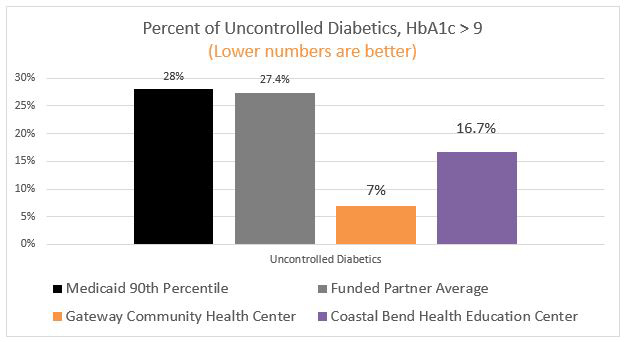
In 2015, two Methodist Healthcare Ministries funded partners, the Gateway Community Health Center in Laredo and the Texas A&M Health Science Center – Coastal Bend Health Education Center, did remarkably well at controlling HbA1c levels in diabetic patients.

The term HbA1c refers to glycated haemoglobin. It develops when haemoglobin, a protein within red blood cells that carries oxygen throughout your body, joins with glucose in the blood, becoming 'glycated.' By measuring glycated haemoglobin (HbA1c), clinicians are able to get an overall picture of what our average blood sugar levels have been over a period of weeks/months. For people with diabetes, this is important, since the higher the HbA1c the greater the risk of developing diabetes-related complications. 

Both partners did well at controlling HbA1c in their adult diabetic patients. The rate of uncontrolled HbA1c in Gateway patients was 7%, and the Coastal Bend Health Education Center had a rate of 16.7 %, both better than the Medicaid 90th percentile.

graph

When asked what made them successful, both organizations attributed it to the following components:

  Gateway Community Health Center: Leveraging long-term relationships Coastal Bend Health Education: Consistency and support
Integration Diabetes programs were integrated into medical practice. A multi-disciplinary diabetes education care team for diabetics included: a physician medical director, registered nurses, certified diabetes educator, registered dietitians and community health workers.
Supportive Intervention  Nutritional assessment and counseling: a 10-week diabetes self-management course included weekly outreach by phone to answer questions, and provided support and reminders. Bi-weekly support sessions provided group problem-solving and a buddy system.  A consistent patient-focused approach promoted lifestyle changes, diabetes self-management and social support. This included regular diabetes self-management education classes in English and Spanish, as well as monthly support groups and refresher trainings based on patient needs (i.e. glucometer training). Additionally, a three-part nutritional education course covered topics from food shopping to cooking to eating out.
Trusted Relationships  The community health workers that worked with patients and conducted the diabetes self-management courses had been with Gateway for over 10 years. This experience allowed staff to develop a rapport with patients and anticipate their needs. Community health workers were integrated into the community and facilitated patient access to support services. They followed up on patient progress and made home visits when the patients were identified as high risk with cultural and linguistic barriers. Community health workers enhanced the quality and cultural competence of program service delivery by serving as advocates.
Clinical Knowledge Careful, systematic monitoring of HbA1c at regular intervals helped move diabetics through different levels of support based on test results. All diabetic patients received a follow-up appointment every three months that monitored the progress of their treatment plan. Biometrics were obtained (HbA1c, blood pressure, random blood glucose, weight, BMI and percent of body fat) so patients could see changes in their health. This monitoring also allowed patients with urgent needs (such as a very high HbA1c) to be referred to medical providers for one-on-one crisis care.
Patient Convenience A one-stop shop model made it convenient for patients to access wrap-around services. Diabetic testing supplies were also provided year-round at low cost. Diabetes self-management education classes were offered in the day and in the evening at convenient locations around the region.

A Beautiful Mind art event raises awareness for mental health

On May 7, during National Children's Mental Health Awareness Week, Methodist Healthcare Ministries of South Texas, Inc. teamed up with longtime funded partners the Bexar County Health Collaborative and the San Antonio Clubhouse for a mental health focused art event, A Beautiful Mind.

The unique art experience combined expressive art, discussion, and testimonies to facilitate a dialogue on mental health realities and stigma in Bexar County.

Artists of various backgrounds exhibited work that interpreted what it's like living with mental health struggles – to bridge the gap and create a connection with audience members. High school students from the Henry Ford Academy Alameda School for Art + Design also supported by participating as contributing artists. More than 120 people were in attendance, all encouraged to take action by getting involved and raising awareness.

Methodist Healthcare Ministries President & CEO, Kevin C. Moriarty sat down with Focus South Texas to speak about A Beautiful Mind and mental health awareness.

The event was the idea of high school senior Jazymn Frederick, a student at the Henry Ford Academy. Frederick teamed up with the Bexar County Health Collaborative in an effort to create an avenue to talk openly about mental health. "Art is a way to clear my mind," said Frederick, who fought with depression and anxiety.

Jazmyn Frederick expresses how art is a form of healing.

The Bexar County Health Collaborative – an organization focused on improving the health status of the community through collaborative means – took the lead on this event because of the connection with its Young Minds Matter program, which focuses on advocating, educating, and reducing stigma on youth mental health issues. A Beautiful Mind was held at the Crossroads Campus of the San Antonio Clubhouse – a local non-profit dedicated to providing individuals with mental health struggles the opportunity to live, work, and learn as an included member of society in a stigma free environment.

Methodist Healthcare Ministries is proud to support both organizations: the Bexar County Health Collaborative, which became a funded partner in 2007 and has since been awarded more than $790,000; and the San Antonio Clubhouse, partner since 2005 and awarded more than $2 million since then to aid in its efforts.

One out of every five people lives with a form of mental illness. Methodist Healthcare Ministries, in support of this critical issue, has invested approximately $8,500 in integrated behavioral health and social services in 2016. In addition, Methodist Healthcare Ministries has contributed $500,000 annually since 2001 to the Meadows Mental Health Policy Institute – a non-profit that supports the implementation of policies and programs that help Texans obtain effective, efficient mental health care, and an organization of which Methodist Healthcare Ministries President & CEO, Kevin C. Moriarty, is a founding board member.

Seventy percent of the proceeds of A Beautiful Mind went to the Young Minds Matter program. If you missed the event, there is still a chance to support Mental Health Awareness Month in May and purchase the art online at https://squareup.com/store/healthcollaborative/. Purchases will help further the mission of the Young Minds Matter project and the artists that dedicated their time and talent to A Beautiful Mind.

Remembering our smallest citizens during Child Abuse Prevention Month

On April 5, a cadre of advocates, elected officials, health care providers and volunteers came together to plant nearly 5,000 blue pinwheels on the rolling green lawn at Methodist Healthcare Ministries' corporate headquarters in San Antonio in observance of National Child Abuse Prevention Month.

The memorial preceded an assembly which brought together leaders and decision-makers in San Antonio to discuss how to prevent child abuse and neglect in our community. As I listened to the speakers talk about the 4,941 confirmed victims of child abuse in Bexar County last year, my eyes were drawn to the blue and silver pinwheels, glittering under the sun and spinning thanks to the breeze blowing that morning. Standing among the sea of pinwheels conjured memories of my high school graduation. There were 705 students in my graduating class. I thought about the class photo we took that day, and how I had never seen so many people in one place; it was a tidal wave of caps and gowns. But standing before all the pinwheels now made all the faces in the photo seem like drops in a bucket. I would have to multiply the number of students graduating with me seven times to equal the number of confirmed child abuse victims in just Bexar County alone last year. What's worse, is those are just the confirmed cases of abuse, the number is likely much higher when the number of cases that are not reported is factored in.

Since 2007, Bexar County has been one of five counties in Texas with the highest number of confirmed victims of abuse. In fact, in the years 2007, 2008, 2011, and 2012 Bexar County held the top spot for the number of confirmed victims of abuse as reported by the Texas Department of Family Protective Services, beating out Harris County where the child population is at least double that of Bexar County.

To say child abuse is a problem in our community is a gross understatement. However, the number of confirmed victims in Bexar County has steadily declined in the last four years, in large part due to a concerted community effort to prevent and stop the cycle of child abuse.

Organizations like ChildSafe have done an incredible service to the community by raising awareness and creating a sense of urgency for advocacy through its Cardboard Kids initiative. And, agencies like Family Violence Prevention Services, Inc. strive to break the cycle of violence and strengthen families. Methodist Healthcare Ministries is proud to support both these organizations with funding to sustain their programs and services. In fact, this year, Methodist Healthcare Ministries will invest nearly $10 million in mental and behavioral health programs that offer children, youth and adults access to counseling and other support services.

Methodist Healthcare Ministries also operates programs designed to help parents and guardians become more confident and competent leaders within their families. Last year, the organization served more than 30,000 individuals in its Parenting Programs. Many of the programs' participants self-report having been involved with Child Protective Services. In fact, over 66 percent of the parents who have graduated from Methodist Healthcare Ministries' Nurturing Parenting Program® are in high need or "in crisis" as they are enrolled in the program by way of Child Protective Services referral, incarcerated and about to re-integrate with their families, and/or receiving mental health substance abuse treatment. These numbers speak only for the participants in programming offered by Methodist Healthcare Ministries, they do not include the individuals served through agencies that have received community grants for programs and services they operate. But, these numbers speak to the continued need for parenting support which is a key element in preventing child abuse.

As National Child Abuse Prevention month draws to an end and one-by-one we take up the pinwheels planted as a memorial to the abused children in our community, we at Methodist Healthcare Ministries remain committed to do all the good we can for all the families who rely on the programs and services we provide and support to keep them safe and healthy. And, to continue raising awareness in our community so our smallest and most vulnerable members are protected from harm.

2016 Fiesta Medal Announced

Fiesta is now underway! Methodist Healthcare Ministries of South Texas, Inc. is proud to introduce our exclusive 2016 Fiesta medal.

As an organization that has been headquartered in San Antonio for more than 20 years, Fiesta is a grand celebration that is important to us, as well as the longstanding tradition of Fiesta medals.

Last year, Methodist Healthcare Ministries opened a competition for its more than 350 employees to design the organization's 2016 Fiesta medal. The winning medal, chosen by team members, was designed by Federal Grants and Programs Assistant Mae Barajas.

"Fiesta is a colorful and lively time, and designing this medal gave me the chance to express how proud I am of my city," said Barajas. "I wanted to incorporate San Antonio's artistic landmarks and to reflect how Methodist Healthcare Ministries is a huge part of our city's prosperity."

The medals were given as a gift to employees and community partners making its way through the 74 South Texas counties Methodist Healthcare Ministries operates programs out of.

While the medals are not up for sale, keep an eye out on our social media pages this week for a chance to win a medal to add to your collection!

Facebook: @mhmstx
Twitter: @mhmstx
Instagram: @mhmstx
LinkedIn: linkedin.com/company/methodist-healthcare-ministries

Methodist Healthcare Ministries would like to wish everyone a healthy, happy 2016 Fiesta season!

Reducing patient no-shows through health care technology

By Jane Hevezi, grants specialist

Many clinics that Methodist Healthcare Ministries of South Texas, Inc. supports through community grants share the common problem of patient missed appointments and no-shows and are searching for solutions. In alignment with Methodist Healthcare Ministries' strategy to increase access to care, an innovative solution was implemented in Bandera, Texas by one of our funded partners, the Arthur Nagel Community Clinic, addressing this very issue and empowering patients to engage in their health care.

The clinic's executive director, Bruce Hanks, was determined to find a solution to the chronic no-show problem since many patients face issues such as transportation limitations and are unable to keep an appointment or need to reschedule. He adapted a technological solution – a mobile patient engagement app called CareMessage that has the ability to send appointment reminders via text, send surveys, collect data from any patient population, manage prescriptions, engage patients in chronic disease management, and support patients outside of the clinic with automated health education programs that are bilingual.

"We needed a way to increase patient engagement while improving patient outcomes," said Hanks. "We used CareMessage to send text message reminders to patients, which came in handy not only for appointments but other notifications too – like reminding patients to bring in their medications, or to drink extra water if it was a hotter than normal that day."

Through CareMessage, the clinic significantly reduced the number of no-shows by using the mobile appointment reminder system, which positively impacted the health of patients and increased access to care. In 2014 before CareMessage, the clinic had an almost 30 percent no-show rate. With the use of CareMessage, the number of no-shows reduced by approximately 70 percent in 2015.

Another byproduct of the new technology was the reduction of medical costs. Hanks explained, "If we can see more patients and fewer appointments are missed, then our cost-per-patient visit goes down."

To further address the problem, the clinic has worked to update patient phone numbers at each appointment to ensure they can be reached.

"The most important thing I learned after implementing this software was that folks who were the ones showing up the least were the ones who are the most chronically ill," said Hanks. "I took those statistics to heart and am glad we made changes."

To learn more about the Arthur Nagel Community Clinic, visit www.nagelclinic.org. For more on Methodist Healthcare Ministries' grant-making, click here.

The Arthur Nagel Community Clinic joined Methodist Healthcare Ministries' family of funded partners in 2009. The Clinic provides free primary, preventive, mental and dental health care services to the underserved residents of Bandera County. To date, Methodist Healthcare Ministries has provided more than $462,875 in funding to support the Arthur Nagel Community Clinic.

Pearls of Wellness Wisdom

"Speak up for those who cannot speak for themselves, for the rights of all who are destitute. Speak up and judge fairly; defend the rights of the poor and needy." Proverbs 31:8-9 (NIV)

I start off with this verse because April is National Child Abuse Prevention Month. We know, however, that we must prevent and address abuse each and every day. Having worked as a behavioral health nurse, I am acutely aware of the devastating and destructive effects that physical, mental, emotional and sexual abuse has on a child's life. It is up to the community, agencies, schools, and churches to protect and strengthen families because these institutions have a great influence on family life.

Children thrive on attention, affection, and having their needs adequately met by their parents. They depend on parents to nurture, guide, instruct, and support them on a daily basis and throughout their life span. Children need parents to be a part of their lives, and to be aware of their friends and activities –even when parents aren't very welcomed around their teenage years. Your awareness, knowledge and involvement in the care of children within your family, church, and community can help prevent or stop current abuse. Reporting child abuse and neglect is mandated by law, not just for professionals, but for any person that witnesses or suspects a child is affected. Speak up and be an advocate. Reports can be made to the Texas Department of Family and Protective Services at 1-800-252-5400 or www.dfps.state.tx.us, or to a law enforcement agency. Additional information can be found at www.childwelfare.gov

 You can advocate for children and further help to nurture communities through education, speaking to neighbors, and/or becoming a volunteer at any organization that serves families. If you are unable to physically participate in this manner, you can carry this need in your heart and pray for children and families struggling with these issues. Pray for justice for these little ones. Pray for their healing and protection. Remember to always thank the Lord for your family, little ones, and the life and love that you all share with each other.

In honor of National Child Abuse Prevention Month, please join us at the 19th Annual Hidalgo County Child Abuse Prevention Candlelight Vigil on April 7, 2016, for a public awareness walk to raise awareness and remember those we have lost to child abuse. The walk begins at the CASA of Hidalgo County office building (1001 S. 10th Ave., Edinburg, TX 78539) at 5:45 p.m., and ends at the Hidalgo County Court House lawn where the Candlelight Vigil will take place at 6:30 p.m. For more information, call (956) 381-0346 or visit www.casaofhidalgo.com

My Walk Across Texas Journey

By Wesley Nurse, Lindsey Floyd, RN

As a Methodist Healthcare Ministries Wesley Nurse in Edna, TX, I encourage good nutrition and exercise. My role involves being committed to helping the least served in our community through education, health promotion, and collaboration to achieve improved wellness through self-empowerment. Walking, in particular, is a great form of exercise since it is inexpensive and is an easy way to get fit.

This year, I, along with Jackson County Hospital District, recruited people in Jackson County to participate in Walk Across Texas – a free 8-week statewide program designed by Texas A&M Agrilife Extension to help Texans establish the habit of regular physical activity. The goal is to "walk across the state of Texas" in eight weeks – 830 miles. In order to stay on track, everyone on a team (up to eight people) must walk nearly 13 miles each week.

Our initial goal was to form 10 teams. We are proud to say that we now have 30! We started our challenge on February 16.

The aim is to be the first team to reach 830 miles or walk the most miles. We hope to walk 850 miles. While there is no monetary compensation, the much greater benefit includes reducing your risk of cancer, diabetes, heart disease and stroke. This challenge helps people start moving more to establish physical activity as a lifetime habit. What's also great is since you're working in a team, you have a support system to help you keep going. In fact, you don't even have to walk to participate; you can convert your exercise into mileage, which allows participants to do any type of physical activity that fits their lifestyle. Some of our team members are walking on their own, while others walk together on tracks and city parks.

With just a few weeks to go, all our teams are happy to join thousands of fellow Texans on a daily walk to a better life. We will have an awards night to celebrate our accomplishments on April 12.

If you're interested in participating (anyone can join, even individually), check out the Walk Across Texas website at http://walkacrosstexas.tamu.edu/. To learn more about Methodist Healthcare Ministries' Wesley Nurse program – a faith-based, holistic health and wellness program – visit http://www.mhm.org/programs/community-outreach

President/CEO Kevin Moriarty Celebrates 20-Year Anniversary

Methodist Healthcare Ministries – a faith-based, nonprofit organization dedicated to creating access to health care for the uninsured through direct services, community partnerships and strategic grant-making in 74 South Texas counties – has thrived under Moriarty's direction. He is responsible for executing the overall direction for the organization, executive administration of Methodist Healthcare Ministries' primary care medical and dental clinics, and providing policy guidance to Methodist Healthcare Ministries' board of directors.

Since being selected as the founding president and chief executive officer in February 1996, Moriarty has led Methodist Healthcare Ministries to become the largest private funding source for community health care services in South Texas. Moriarty's implementation of the board of director's strategy of community health has grown from one program in 1996, with 2,900 patient/client visits, less than five funded partners, and a $3.1 million budget, to 21 programs in 2016, 850,000 projected patient/client visits, more than 90 funded partners and a $91.9 million budget. Methodist Healthcare Ministries has been recognized by law makers as a critical voice and advocate for low-income families and the uninsured. Through its public policy analysis and research, and as a result of Moriarty's direction, Methodist Healthcare Ministries has helped to ensure Texans have greater access to health care services.

In addition, Moriarty oversees the quality and charitable management of the Methodist Healthcare System, San Antonio's second largest private employer of which Methodist Healthcare Ministries is one-half owner. This creates a unique avenue to ensure the Methodist Healthcare System continues to be a benefit to the community by providing quality care to all, and charitable care when needed. Under Moriarty's leadership at Methodist Healthcare Ministries, and through his role on the Methodist Healthcare System's Board of Governors and its Community Boards, both organizations have made great strides in working to achieve a high standard in community care.

Prior to his service at Methodist Healthcare Ministries, Moriarty served as a public official with the City of San Antonio for more than 20 years. The last position he held was as director for the Department of Community Initiatives. A native New Yorker, Moriarty received his B.A. from St. Francis College in Brooklyn, New York, with areas of concentration in history, economics and philosophy. He earned a Master of Science in Urban Studies from the City University of New York with a concentration in public administration, health and human services planning, manpower planning and data analysis. Moriarty continued his education through the Harvard Business School Executive Program in 1997, and the Executive Program for Philanthropy Leaders through Stanford Graduate School of Business in 2006.

Moriarty also served as a member of the Peace Corps in Liberia, West Africa for two years as a teacher for elementary and secondary schools.

Today, Kevin resides in San Antonio with his wife and five children. Methodist Healthcare Ministries is honored to celebrate this grand milestone and looks forward to continuing prosperously under his leadership. Congratulations, Kevin!

School Based Health Centers Celebrate 15 Years of Service

Methodist Healthcare Ministries of South Texas, Inc. is proud to celebrate the 15th anniversary of the opening of our School Based Health Centers.

Since 2001, the School Based Health Centers at Krueger Elementary and Schertz Elementary have helped children in the Schertz-Cibolo-Universal City and Marion Independent School Districts (as well as their siblings up to age 21) have access to pediatric primary health care, dental services and a comprehensive range of services.

Methodist Healthcare Ministries invites you to celebrate this milestone with us, along with National School-Based Health Care Awareness Month in February, by attending our Open House on Tuesday, February 23, from 3:00 p.m. to 4:30 p.m., at the School Based Health Center at Schertz Elementary (757 Curtiss Ave., Schertz, TX 78154). Come tour our clinic and meet the team of professionals who provide our medical, dental and social services. Click here to register: http://www.mhm.org/events/416-school-based-open-house.

To schedule an appointment at one of our School Based Health Centers, contact:

School Based Health Center at Krueger Elementary
217 West Otto Street
Marion, TX 78124
(830) 420-2291

School Based Health Center at Schertz Elementary
757 Curtiss Ave.
Schertz, TX 78154
(210) 658-4875

We hope you will join us so that we may work together to help our youth stay happy and healthy!

Partnerships make for progress in the area of mental health

If there's one thing I've learned from my more than two decades of treating and addressing mental health issues, it's this: there is no greater power than the power of a strong partnership. This partnership I speak of takes shape in a multitude of ways. Partnering with our patients to be allies in health; partnering with a multidisciplinary team of providers to strengthen treatment plans; and partnering with the community to augment the health care landscape within in our area.

It is with this notion that I am so proud of one of Methodist Healthcare Ministries' latest partnerships. For those who do not know, Methodist Healthcare Ministries offers behavioral health services at our clinic locations in the San Antonio area (Wesley Health & Wellness Center; Bishop Ernest T. Dixon, Jr. Clinic; and School Based Health Centers), and through community and church sites throughout our 74-counties in South Texas as part of our Community Counseling program.

And, although, I know from our clients we are addressing a need, I also recognize there are demands we are not equipped to address. That's where that powerful word, "partnership," comes into play.

To fill a void our behavioral health services team recognized, Methodist Healthcare Ministries recently partnered with Family Service Association – a non-profit agency in San Antonio dedicated to helping children, seniors, and families in need – to house a full-time Financial and Vocational Counselor at the Wesley Health & Wellness Center and Bishop Ernest T. Dixon, Jr. Clinic to serve as an in-house point of referral for Methodist Healthcare Ministries' patients and clients.

The partnership model takes the patient's/client's social determinants of health into consideration as part of the treatment available through Methodist Healthcare Ministries' two San Antonio-based clinics. As poverty is one of the strongest risk factors for poor health, this partnership is designed to help low-income individuals improve their financial health and provide them with skills and education to prevent them from being in subsequent financial emergencies.

A counselor will work on an individual's budget and teach them how to pay off debt. The partnership will also allow for one-stop access to job training programs.

As this partnership continues, I hope to see a positive effect on our emergency assistance program. If we can find ways to empower people to take control of their health – both physical and financial – perhaps we will ease the burden or stress financial crisis creates for our patients and clients.

Ultimately, by pairing financial and vocational counseling with other social services, we are better able to overcome barriers that may affect one's mental and physical health like minimal educational attainment, insufficient job skills, ineffective support systems; lack of individual employability; and intergenerational cycles of poverty.

White close icon

Jaime Wesoloski

President & Chief Executive Officer

Jaime Wesolowski is the President and Chief Executive Officer at Methodist Healthcare Ministries. A healthcare executive with three decades of leadership experience, Jaime is responsible for the overall governance and direction of Methodist Healthcare Ministries. Jaime earned his Master’s Degree in Healthcare Administration from Xavier University, and his Bachelor’s of Science from Indiana University in Healthcare Administration. As a cancer survivor, Jaime is a staunch supporter of the American Cancer Society. He serves as Chair of the American Cancer Society’s South Texas Area board of directors and he was appointed as Chair to the recently created South Region Advisory Cabinet, covering eight states from Arizona through Alabama. Jaime believes his personal experience as a cancer survivor has given him more defined insight and compassion to the physical, emotional, and spiritual needs of patients and their families.