


Annual Grant Cycle
In 2023, Methodist Healthcare Ministries took time to examine current philanthropic industry best practices, identify gaps in the service-area resource landscape, and consider how our grant support can be most impactful in serving the least served.
Building upon our health equity strategy, we incorporated equitable grantmaking principles to reduce administrative burdens for grantees and to provide more flexible funding. We sought and incorporated feedback from stakeholders across our region and within our organization. Many of of our valued funded and community partners joined our effort by providing insights, and we are grateful. As a result, we introduced new approaches to grantmaking with our 2026 grant cycle. These changes will continue going forward, and MHM will seek new ways to improve our grantmaking journey.

Open Grant Cycle
Proposals are welcome from organizations serving communities within our 74-county service area. Applications selected for funding will align to priorities within each focus area as outlined by the Community Investment’s Theories of Change. The Theories of Change will provide clarity and offer potential measures for each focus area with the intent to inform the scope of applications, clearly communicate MHM priorities, and ultimately result in a more efficient and transparent process for grant.
Cornerstone Grants
As illustrated in Isaiah 28:16, a Cornerstone serves as a critical beginning block in construction that provides a strong foundation to build upon as well as directional alignment. In this spirit of strong foundations, MHM offered invitation-only Cornerstone Grants to select Access to Care and Food Security long-term partners who have consistently demonstrated outcomes aligned to MHM’s Theories of Change. Cornerstone invitations were sent directly to organization contacts. Many of these organizations have been pivotal in safeguarding access to care in their communities, whether through clinical care, mental health services, or as food banks serving our region. These organizations have helped inform our grantmaking strategy as we have broadened the definition of healthcare to address the Social Determinants of Health. We know we they will continue to play an integral role in our health equity strategy.
Grant Guidelines

What We Look For:
In alignment with MHM’s Funding Philosophy, Community Investments strives to be transparent and accessible, providing prospective partners with a clear understanding of how our grants can support their goals. We recognize and appreciate the time and effort required to prepare an application.
While not an exhaustive list, we give priority to proposals that demonstrate:
Collaboration
We believe that best work is done together, and impact is greater with collaboration. We seek partners who are active participants in local collective efforts and deeply connected in their communities.
Community Perspectives
We value the insights and deep personal knowledge that residents with lived experience bring to programs and organizations. We look for partners that intentionally incorporate community voice into decision-making.
Serving the Least Served
Our mission focuses on supporting economically disadvantaged, geographically underserved, and historically disenfranchised populations.
Systemic Change
We recognize that disrupting the complex cycle of intergenerational poverty requires a combination of solutions and an integrated approach. We seek programs that address the root causes of health inequities.
Geographic Priorities:
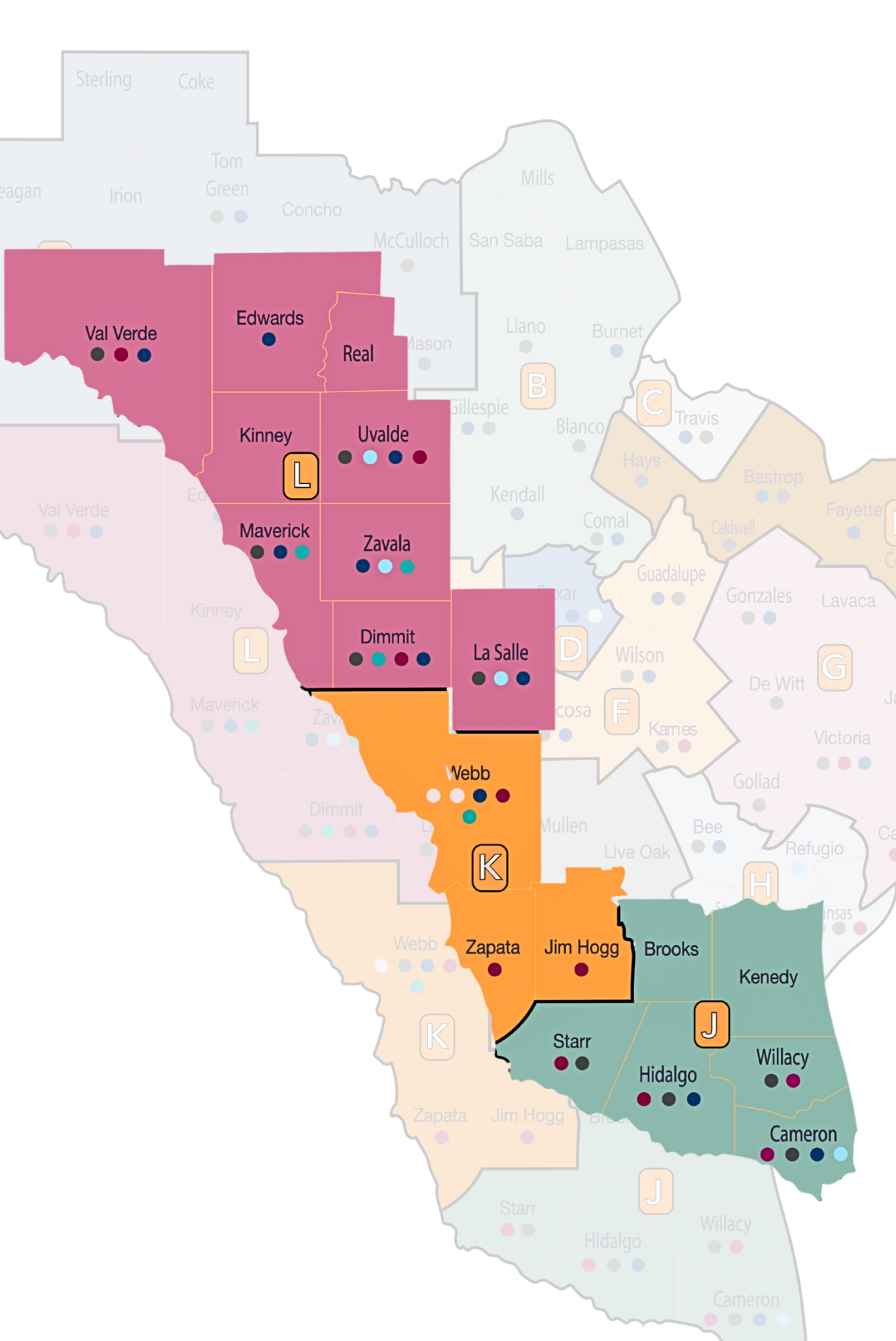
MHM will award approximately $15M-$17M through the 2027 Open Grant Cycle. In reviewing applications, MHM has a strong preference for requests that:
- Align with our Focus Areas
- Serve rural counties or zones J, K, and L of MHM’s Areas of Strategic Opportunity.
- Serve at least one of MHM’s priority zip codes in Bexar County
Bexar County
In Bexar County, new funding will only be awarded to organizations that serve MHM’s 13 priority zip codes and offer solutions that address root causes and seek to improve community conditions. MHM will not consider county-wide requests intending to serve both priority and non-priority zip codes. The Bexar County priority zip codes are: 78201, 78204, 78207, 78211, 78214, 78217,78221, 78222, 78224, 78225, 78226, 78228, 78237.
Eligibility:
MHM does not award grants to organizations that willfully discriminate against any particular class of individuals. To be eligible for funding, organizations must comply with all applicable local, state and federal anti-discrimination laws in hiring, employment practices and service provision.
To apply, an applicant must:
- Be recognized by the IRS as a 501 (c)3 organization or other tax-exempt entity.
- Have a 501(c)3 or tax-exempt status for at least one year or have a fiscal sponsor that has.
- Provide services within at least one of MHM’s 74 service counties.
Previous grantees must be in good standing, which means:
- No significant unspent grant funds at the end of the grant period
- Strong overall organizational financial and programmatic standing

Organizations with an existing multi-year grant are not eligible to apply for the 2027 grant cycle. If you are unsure of your organization’s status, contact CommInvestments@mhm.org or your program officer. Organizations with a Digital Equity grant renewed for 2027 & 2028 are eligible to apply.
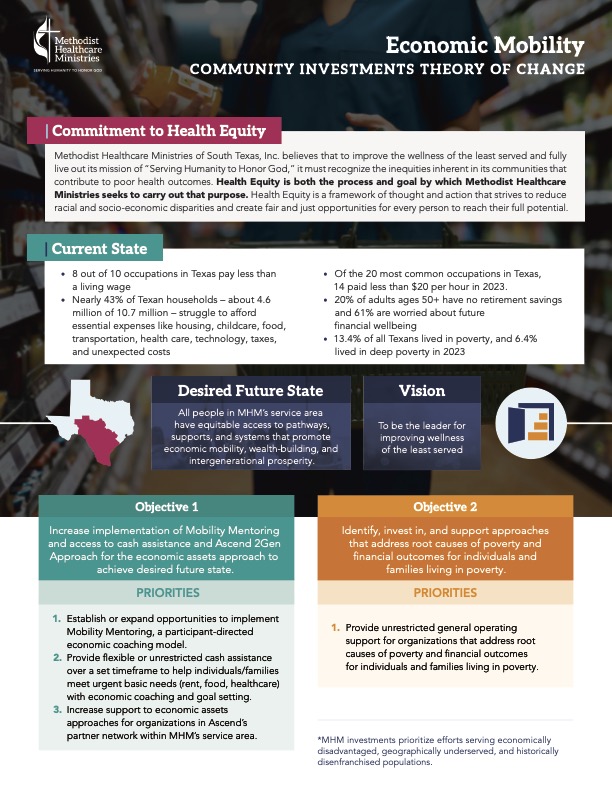
MHM’s Community Investments prioritizes proposals that align with the focus areas. The five Community Investments Focus Areas are drawn from MHM’s strategic pillars as identified in our current strategic plan. Funding requests must address one or more of the following Focus Areas:
- Access to Care: Mental and Behavioral Healthcare
- Access to Care: General
- Digital Equity
- Food Security
- Economic Mobility


Theories of Change
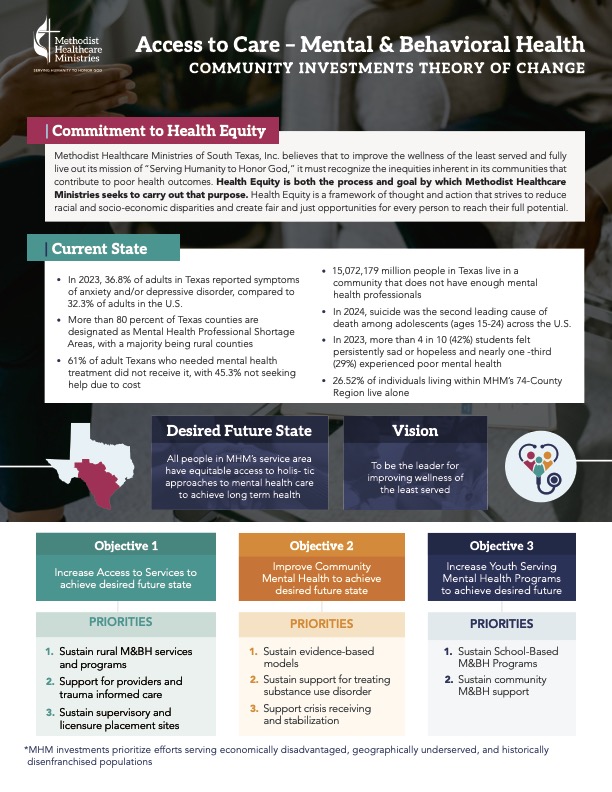
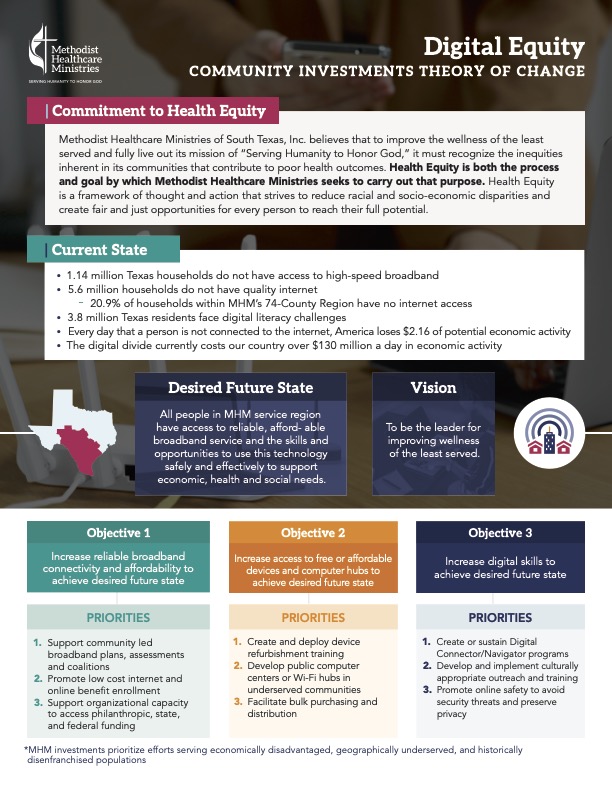
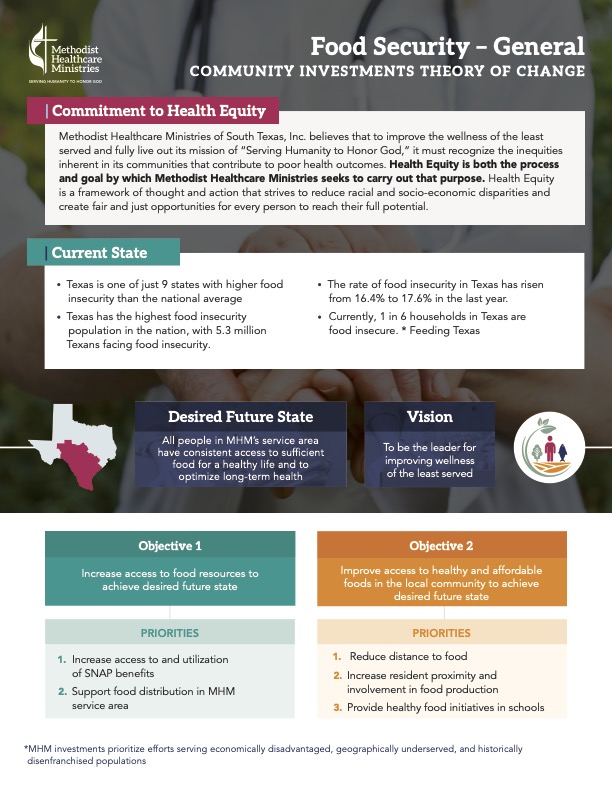
The Community Investments Focus Areas and Theories of Change help our grantees and MHM strengthen strategies and maximize results by defining success and outlining the path toward health equity. They were developed collaboratively, incorporating valuable insights from esteemed partner organizations and community members to ensure that South Texas community voices were incorporated and current needs were accurately identified.
The Theories of Change present objectives and priorities for each focus area. These are intended to serve as guides and not a comprehensive list of eligible programs or metrics.
Review the Theories of Change for detailed information about objectives, priorities, and sample metrics for each focus area. If you have questions about your specific request, contact us at CommInvestments@mhm.org.


Grant Types
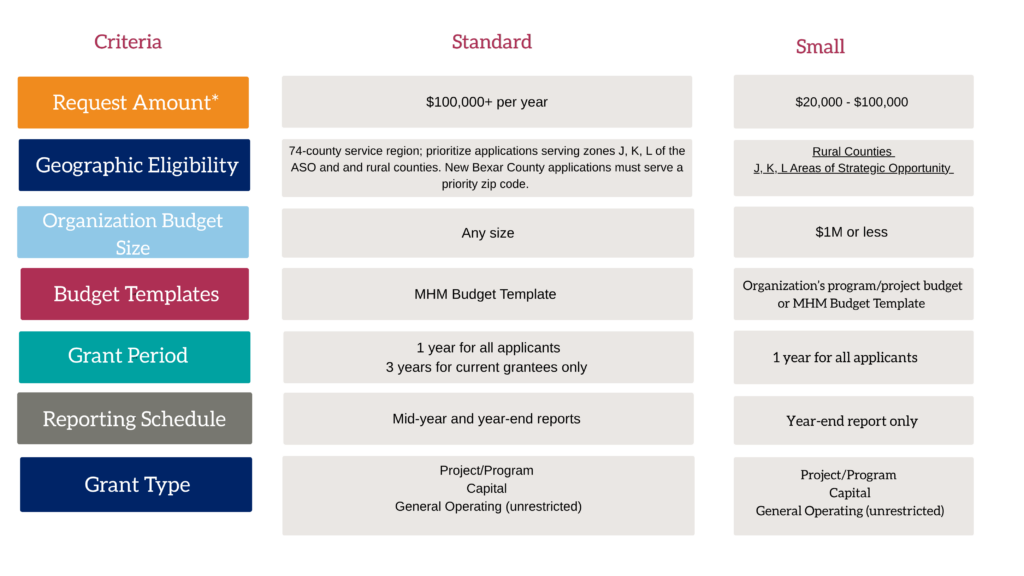
MHM will fund three grant types: Project/Program, Capital, and General Operating through two application tracks: Standard and Small.

Project/Program
Support to establish or sustain new, existing, or expanded program or projects.
May include capital/renovation costs or capacity building costs associated with the project/program. To add it to the project budget template, add a line item for:
- Capacity building costs, up to 20% of the total grant request
- Capital/renovation costs, up to 50% of the total grant request
Example: A grant to add a facilitator and purchase materials for a nutrition program at a new location, including renovation of a room (new flooring, lighting, and paint).
Capital
Support for facilities or infrastructure that enable organizations to acquire, construct, or renovate physical assets that contribute to long-term sustainability. Eligible for single-year grant requests only.
Capital grants do not include program/project or capacity building expenses.
Example: An organization has purchased a new building. The organization submits a grant request to replace the roof.
General Operating
Unrestricted support for a nonprofit’s mission to sustain day-to-day operations. Organization’s mission and purpose address one or more of MHM’s focus area priorities
Standard grant applicants must meet specific criteria to apply for a general operating Standard grant, including:
- Financial Criteria
- Organization’s annual budget is $10M or less
- Organization must have an accounting system with financial reporting capabilities.
- Organization may not have significant deficiencies in the financial audit
- Organization must be considered low risk based on financial statement review by MHM staff
- IRS 990 form is completed annually and timely for the organization
- For Current Grantees:
- Provided annual accounting system generated fiscal year-end financial statements
- Provided accounting system generated current year to date financial statements
- Organization has a 3rd party audit conducted within the past fiscal year and provided a copy to MHM
- For New Applicants:
- Provided two years of accounting system generated fiscal year-end financial statements
- Provided accounting system generated current year to date financial statements
- Organization has a 3rd party audit conducted within the two fiscal years and provided both copies to MHM
- Organization Criteria
- Organization is 501c3 nonprofit (excludes government entities, colleges, and universities)
- Organization has an active Board of Directors
- Organization has at least one paid staff member
Open Cycle Application Tracks
Organizations eligible for both a Small and Standard grant may submit only one application under either the Small grants or Standard grants application track. After reviewing the submitted application, MHM may elect to fund the request in part or in full.
Small Grant Track:
- Only eligible for applicants serving rural counties or the J, K, and L Areas of Strategic Opportunity
- Available to organizations with annual budgets $1M and under
- Request amounts between $20,000 – $100,000 (the requested amount may not exceed 20% of the organization’s operating budget)
- May submit their own organizations’ budget for proposals
- If awarded, year-end reports required
- Eligible for all grant types including general operating support.
Standard Grant Track:
- Applicants can serve in any of the 74 counties in MHM’s service area (Unless No Bexar)
- Request amounts over $100,000
- Must use the MHM Budget Template
- If awarded, mid-year and year- end reports required
- Eligible for specific funding in either programs/project, capital, or capacity building.
MHM Community Investments awards approximately $35M in grants annually across our service area. For the 2027 Open Cycle, we anticipate awarding approximately $15M-$17M, as a portion of funding has already been committed through multi-year grants.
Grant Request Amount
Annual grant request amount may not exceed 20% of the overall organizational budget. The typical grant size for a Standard Grant is $220,000 – $250,000 annually.
Grant Period Options
Single-year: New applicants and current MHM grantees in good standing may apply for a 1-year grant, to be made available for a 12-month period between January and December 2027.
Multi-year: Organizations with a 2026 grant are current grantees and are eligible to apply for a 3-year grant to be made available for a 36-month period between January 2027 and December 2029. Current grantees must be in good standing and are encouraged to reach out to their program officer to discuss their multi-year application and proposed work.
Grant Goals
The grant application must include goals that describe what you aim to accomplish with the requested funds within the grant period.
- The goals must be aligned to the Priority or Priorities listed on one or more focus area Theories of Change and align to your grant application and request budget.
- The mid-year (if applicable) and year-end grant reports will ask for updates on the progress toward these goals.
- Each application will include a minimum of two and a maximum of five goals.
Two goals must be quantitative, and the others can be either quantitative or qualitative. Additional guidance on preparing grant goals is available below or by referring to the Goals and Metrics Guide for Applicants in the Grants Resource Library.
In the application, you will first copy and paste a priority from a Theory of Change, then you will write your goal and list your metric(s) as demonstrated by the example below.
Theory of Change: Access to Care – General
Priority: Provide outreach and education around healthy behavior
Goal: Within a 3-month period, 90% of people attending the diabetes self-management classes will participate in experiential learning that promotes best practices for diabetes self-management by exhibiting at least 4 of the following self-care behaviors over the course of the 6-week program: personal blood glucose check; track carbohydrates; identify carbohydrates, proteins, and fats; participate in exercise; practice a stress relieving activity. Activities will be tracked through participant logs collected on a weekly basis.
Note: This goal includes SMART (specific, measurable, achievable, relevant, and time-bound) objectives, trackable metrics with targets, and plans for collecting data.
Quantitative goals are based on numerical data that can be measured or counted to describe activities or outcomes. Examples include the number of pounds of food distributed, A1c improvements, PHQ-9 improvements, number of services a client receives, number of devices distributed, and number of certifications gained by students. Tools to collect quantitative data include logs or trackers, surveys, baseline and end surveys, and randomized controlled trials. | Quantitative Goal Example: |
Qualitative goals are based on non-numerical data that cannot be easily counted and can help explain why, how, or what of activities or outcomes. Examples include testimonies of improved quality of life due to an intervention, or participants in digital literacy programs describing the impact of acquiring devices. Tools include interviews, observations, document review, focus groups, and case studies. | Qualitative Goal Example |
Refer to the Theories of Change for additional examples.
Grant Request Budget
The application includes a section to upload the budget for your grant request. General operating requests will only upload their organization’s Board of Directors approved annual operating budget for their current fiscal year.
The MHM budget template is available for download in the Grants Resource Library.
Small Grant Track: Applicants may submit their organization’s existing program or project budget or use MHM’s budget template.
Standard Grant Track: Applicants must submit on MHM’s budget templates for single-year or multi-year.
Review the Instructions tab on MHM’s budget templates carefully before submitting your application.
Unallowable Costs
MHM will not fund:
- Endowments
- Financial deficits or debt reduction
- Fundraising events
- Requests from individuals for scholarships
- Insurance (unless for a capacity building or capital grant)
- Land
- Legal fees (litigation related)
- Lobbying on behalf of a political candidate
Indirect Costs
Indirect costs are expenditures shared across multiple projects or programs within an organization and are therefore difficult or impossible to attribute to a specific project or program. These costs exist whether or not a particular program runs. Examples include utilities, administrative staff salaries and benefits, legal services, and rent.
Indirect Costs Policy
- Allowed at a maximum rate of 15% of direct costs.
- Allowed for universities/colleges up to 10%.
- Not allowed for government agencies or municipalities.
- Not applicable for General Operating grants.
- Not allowed for capital expenses, equipment purchases, or bulk computer purchases.
- Only allowed to be included at time of application.
Review Community Investment’s Indirect Cost Guidelines for additional details.
Fiscal Sponsorship
A portion of the requested grant monies is allowable for sponsor responsibilities. If you are applying with a fiscal sponsor, contact MHM when completing your budget for guidance on allowable fiscal sponsor fees.
Grant Payment Schedule
Several payment schedule options are available to meet the needs of grantees. You will choose one of the payment schedules listed below on the grant application. The first grant payment is dependent upon execution of the grant agreement. MHM will not begin processing payments until the grant agreement is fully executed. Once the grant agreement is signed by the grantee and MHM, the grant payment will be processed within 30 days but no earlier than January 5, 2027.
Please note that for multi-year requests, the payment schedule is based on the annual grant amount, not the total request amount.
The table below represents the payments for program, Cornerstone, and small grant types only. Capital grant types are not eligible for the payment schedules below. Capital grant types quarter 4 payment is based on a mid-year reconciliation. Underspent funds at reporting time will be reduced from the following grant payments after reconciliation.
| Requests $100,000 and over | Requests under $100,000 |
Annual | N/A | Full grant award amount within 30 days of executed Grant Agreement but no earlier than January 5, 2027. |
Biannual | N/A | 1st payment* 50% of grant based on award amount September Up to 50% of grant based |
Quarterly | 1st payment* 25% of grant based on award amount April 25% of grant based on award amount July 25% of grant based on award amount October Up to 25% of grant based on award amount | |
Monthly | Jan. – Dec. Even monthly grant payments based on award amount *Note: 1st payment issued within 30 days of executed grant agreement but no earlier than January 5, 2027. | |
*Note: 1st payment issued within 30 days of executed grant agreement but no earlier than January 5, 2027.
Financial Statements
The open-cycle grant application includes a section to upload your organization’s financial documentation.
- New applicants for the standard grant track and 2026 MHM CI Grantees must submit the following financial documents for the time periods specified in the table below.
- New applicants for the small grant track are not required to submit any of the following financial documents.
| New Applicants Standard Track | 2026 MHM | New Applicants Small Grant Track |
Fiscal Year End Financial Statements | Two most recent years | Most recent year only | NA |
Current Year to Date Financial Statements | Most recent | Most recent | NA |
External Audit Report (if audited) & Government Grant Audit Report (If required due to receiving government grant dollars) | Two most recent years | Most recent year only | NA |
If you are unsure if your organization received a Community Investments grant in 2026, review the list on our website: https://www.mhm.org/grantmaking/
How & When to Apply
Step 1: Review Community Investments Grant Materials
- Eligibility & Grant Guidelines
- FAQs
- Theories of Change
- Application (.pdf)
- Budget Template
- Community Investments Gossary
Step 2: Attend/Watch the 2027 Grant Cycle Informational Webinar
On June 11, 2026, MHM will host a live webinar providing information about MHM’s grant making updates, funding priorities, and how to apply to the 2027 Grant Cycle.
The recording will be posted to the website following the live session. Applicants with outstanding questions are encouraged to attend the live session and participate in the Q&A or include their questions in the webinar post-survey.
To watch the pre-recorded convening, click here.
Step 3: Access the Online Grant Portal
Preview copies of each application are available to download in the Grants Resource Library below. These documents are provided for planning purposes only and allow applicants to review questions and required attachments before accessing an online application form.
MHM uses the Fluxx online grants portal for application submissions. To access the online application forms, please follow the instructions below based on your user status. For best functionality, we recommend using Chrome, Firefox, or Safari.
Current Users
If you already have an MHM Fluxx account, log in at https://mhm.fluxx.io using your credentials. Applications are available in the “Grant Opportunities” section.
If you forgot your password or are unsure whether you have an account, select “Forgot Password” on the sign-in page. Fluxx will email you instructions to reset your password. If you do not receive an email, you likely do not have a user profile yet and should follow the instructions for New Users below.
New Users
To create an account, first complete the eligibility quiz for the grant opportunity you wish to apply for:
- Open Cycle Standard Application: https://mhm.fluxx.io/apply/opencallstandard
- Open Cycle Small Application: https://mhm.fluxx.io/apply/opencallsmallgrants
If eligible, you will be directed to a registration form. Submit the form for review by MHM staff; allow up to three business days for processing. Once approved, you will receive an email with instructions to create your password.
After setting your password, log in to the MHM Fluxx Grants Portal at https://mhm.fluxx.io. Applications are available in the “Grant Opportunities” section.
For technical assistance, contact CommInvestments@mhm.org.
Step 4: Submit an Application
Only applications submitted through the online grants portal will be accepted. Submission of an application does not indicate a commitment of funding. Late applications will not be reviewed.
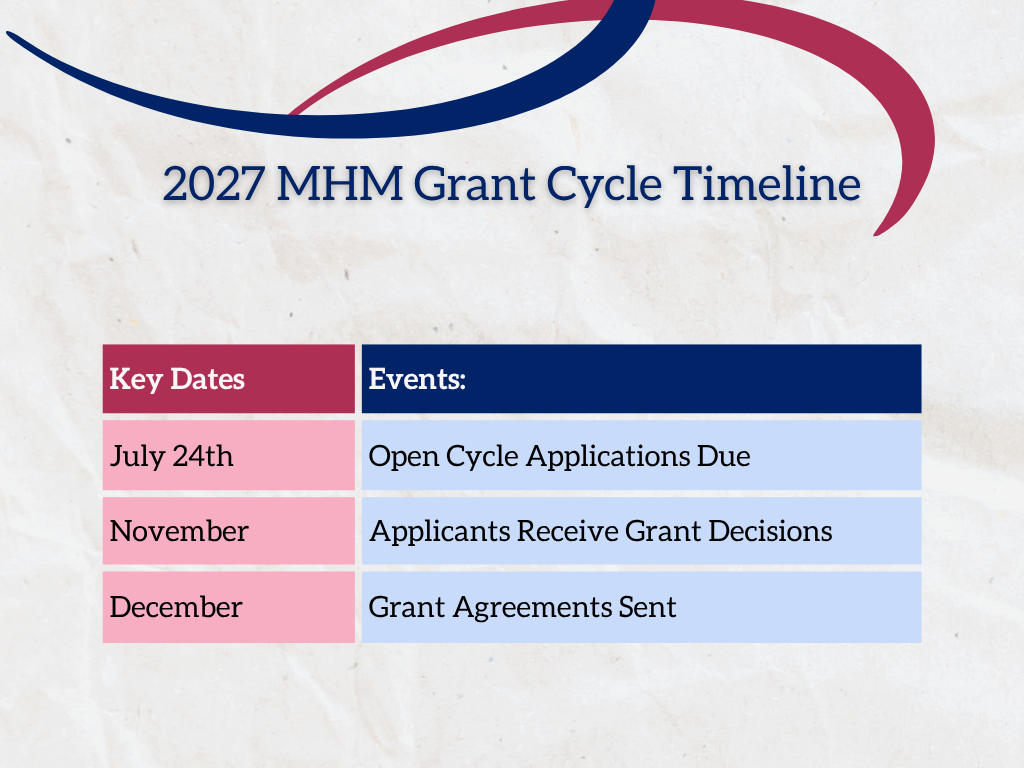
- Applications are due July 24, 2026, at 5 pm CST
Step 5: Receive Notifications
Applications will be reviewed through October by our internal staff and Board of Directors. Organizations selected to receive a grant will be notified of the status of their application by December.
Mid-Year & Year-End reports are required for grantees with single-year or multi-year program/project and capital grants.
Year-End reports (no mid-year) are required for Cornerstone grantees and Standard grantees with single-year or multi-year general operating grants.
Due Dates
Typically, the mid-year reports are due in July, and the year-end reports are due in January following the end of the grant year.
Grantees can expect to receive a notification from their program officer and the online grant portal at least two weeks before reports are due. Upon submission of the report, grantees will receive a confirmation email when the reports are received through the online grant portal.
Narrative Reports
Narrative reports typically include written updates on progress toward grant goals, challenges, successes, testimonials, and grant highlights.
Budget-to-Actual Report
As part of the Mid-Year and Year-End reports, grantees will submit a budget-to-actual financial report on a template provided by MHM, comparing the budgeted MHM grant expense amounts to the actual MHM grant expense amounts, and providing variance explanations as required.
MHM does not require the submission of transactional documentation (such as receipts or general ledgers) for grantees to receive their payment. However, MHM reserves the right to conduct an audit of all funds received and expended during the grant period.
Pending payment disbursements are contingent on meeting all grant reporting requirements and maintaining good standing: no significant unspent funds, good overall financial and program standing).
Financial Statements
MHM will fund three grant types: Project/Program, Capital, and General Operating through two application tracks: Standard and Small.
MHM Financial Reconciliation Process & Unspent Funds
For multi-year grant, underspent funds identified during mid-year reconciliation will be deducted from subsequent grant payments.
At the end of the grant period, MHM may request the return of any unspent funds.
Site Visits
In addition to formal reports, Program officers and other MHM staff may be asked to participate in site visits virtually or in-person throughout the grant period.
Additional Questions
For multi-year grant, underspent funds identified during mid-year reconciliation will be deducted from subsequent grant payments.
At the end of the grant period, MHM may request the return of any unspent funds.
